

Light
How Bright Should a Hat Light Be?
Brighter is not always better on your head. Most of what a hat light does happens on the low and middle settings, and the top one is for the dark trail, the far end of the yard and the engine bay, where it earns the hours it costs.
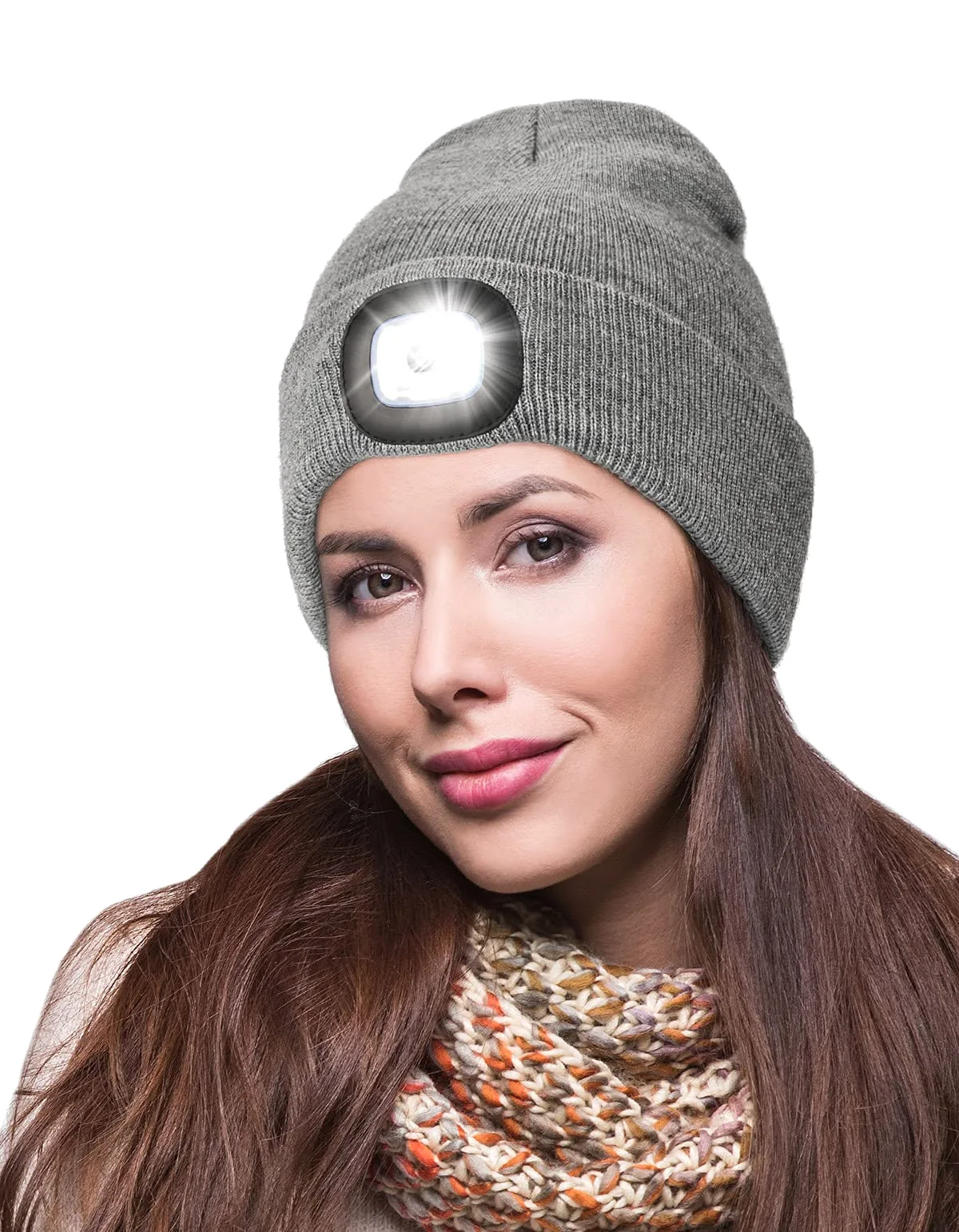
It is ten past six in January. The dog is at the door, the leash is in one hand and the bags are in the other, and the street outside is dark until the next lamp post. You do not need a searchlight. You need enough light to see the curb, the ice and whatever the dog has found, and you need it to still be there tomorrow morning. That is the real question behind lumens: how much light the job in front of you takes, and how long a charge lasts at that setting.
What 120 lumens buys you
Lumens measure the total light a unit puts out. On our LED Beanie with Light four bulbs give up to 120 lumens, split across three brightness settings. The Kids LED Beanie uses the same four bulbs and 120 lumens, and its light reaches up to 30 feet, roughly the length of two parked cars.
Thirty feet is plenty for walking. You look a few steps ahead for your footing and a little farther for the next turn, and a light on your head follows your eyes without you thinking about it. It is less useful for spotting something at the far side of a field, and that is fine. A hat light is for the space you are moving through and the work in your hands.
Three levels matter more than the peak number. They let you match the light to the distance, and every step down buys run time. Here is how five of our hats with a light compare.
| Hat | Bulbs and output | Levels | Hours on a charge |
|---|---|---|---|
| LED Beanie with Light | 4 bulbs, up to 120 lumens | 3 | Up to 4 left on, up to 8 switched on and off |
| Fleece-Lined LED Beanie | Not stated | 3 | Nearly 8 |
| Fleece-Lined Reflective LED Beanie | Not stated | 3 | 2 to 8 |
| Kids LED Beanie | 4 bulbs, up to 120 lumens | 3 | Up to 4 left on, up to 10 per charge |
| Kids LED Beanie with Pom-Pom | 4 bulbs, up to 120 lumens | 3 | Up to 4 left on, up to 8 per charge |
The Kids LED Beanie with Cuff runs 2 to 8 hours and steps through its levels with one button. Our LED beanie guide compares it with the rest.
Match the setting to the job
The middle setting covers most evenings. Here is where the other two come in.
| Job | Setting | Why |
|---|---|---|
| Dog walk on lit streets | Low, or off under the lamps | You mainly need your footing and the bag, and the light marks you for drivers |
| Dog walk on an unlit path or in the park | Middle, top for the darkest stretch | You want the ground a few steps ahead and the edge of the path |
| Walking to the bus or the train before sunrise | Middle | Enough to see the curb and to be seen by a driver turning in |
| Under the hood or under the sink | Low | Close up, the top setting glares off metal, enamel and white plastic |
| Taking out the trash, the far end of the yard, the campsite | Top | This is where the reach counts |
On the dog walk
The dog walk is where a hat light earns its place, because it is the one job where both your hands are always busy. The leash is in one, and the other is either holding a bag or reaching down. A flashlight in your pocket is no help, and a phone light points at the ground the moment you bend.
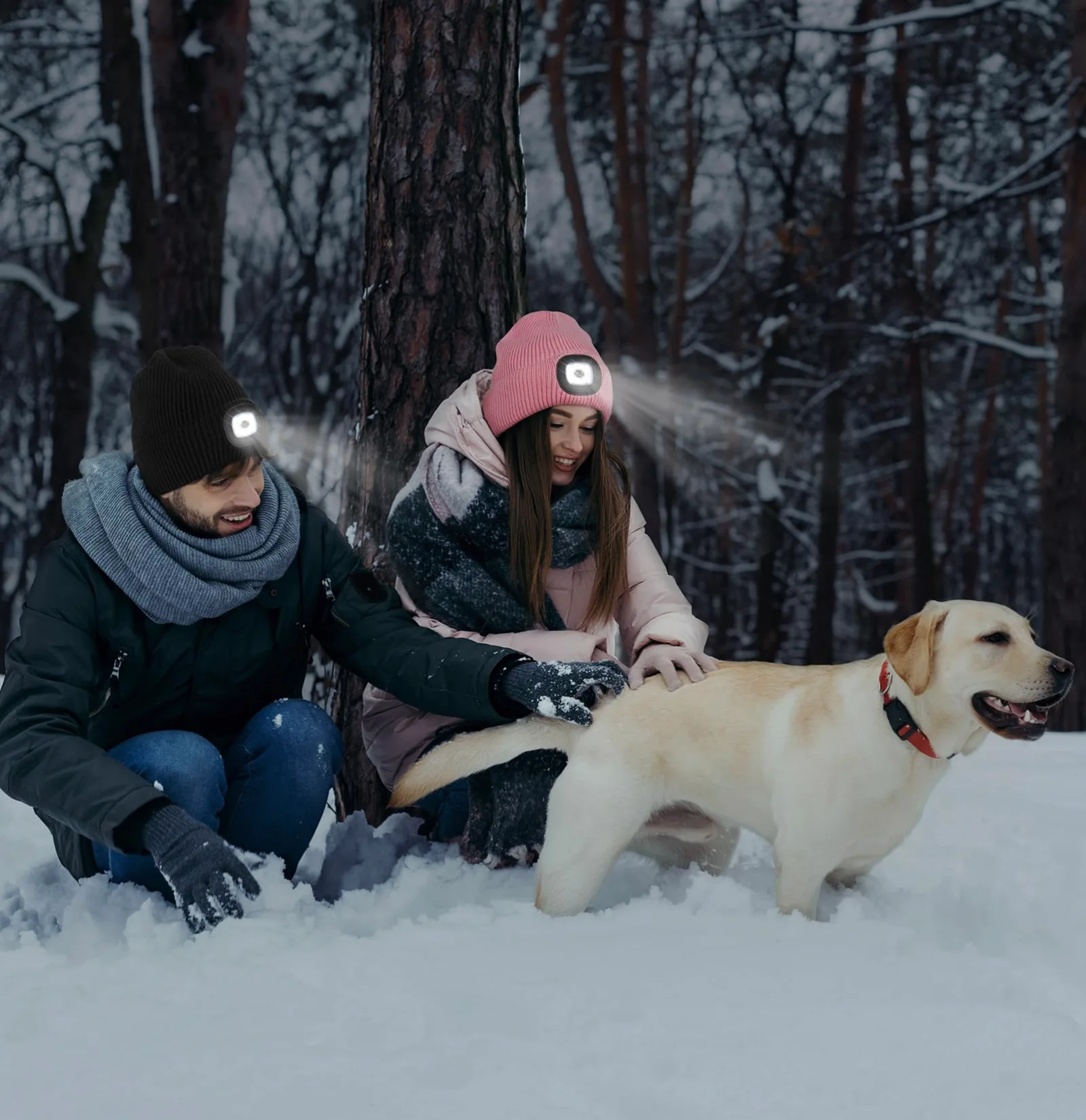
On a lit street, try the low setting, or switch the light off between lamp posts and on again at the dark gaps. On an unlit path, the middle setting shows the ground two or three strides ahead, which is what you need to spot ice, roots and the things your dog wants to eat. Save the top setting for the moment the dog runs off into the dark and you need to see where it went.
On the commute
Walking to work in winter is a different problem, because the point is less what you see than who sees you. Most pedestrian deaths, 77 percent by the NHTSA count, happen after dark, and people on foot tend to think drivers see them sooner than they do. The Federal Highway Administration puts a number on it: a person in dark clothing is first seen by a driver at about 55 feet.
A light on your head changes that, because it does not wait for a headlight to find you. NHTSA counts lights among the aids that help pedestrians be seen, and the FHWA advice for walking at night ends with carrying a flashlight. A middle setting is enough for this. A driver turning out of a side street sees a point of light at head height long before the beam reaches your coat.
If you walk with traffic coming up behind you, look at the Reflective Stripe LED Beanie. You can turn it so the light faces backward, toward the cars behind, while the reflective stripe runs all the way round the hat. Our guide to being seen at night goes further into what reflectors and lights each do.
Under the hood and under the sink
Close work is where people reach for the top setting and then squint. Twelve inches from a white sink basin or a chrome bracket, 120 lumens bounce straight back at you, and the glare hides the bolt you are trying to find. Drop to low. The light then lands exactly where you are looking, which is the advantage a hat has over a work light clamped to the fender.
Two habits help. Tilt your head rather than the work, so the light falls into the gap instead of across it. And wear the cuff folded so the light sits on your forehead, not over one eyebrow, or it will cast the shadow of your own hand onto the job.
How long a charge lasts in practice
Our four-bulb lights give two run times, and the gap between them is your best tool. Left on without a break, the light lasts up to 4 hours. Switched on and off the way a real evening goes, one charge covers up to 8 hours of use. The Kids LED Beanie goes further, up to 10 hours per charge.
Run the arithmetic for your own week. Two half-hour dog walks a day with the light on the whole time come to an hour a day, so the 4 hours left on is up to four days between charges. Switch it off under the street lamps and the same charge stretches toward a week. If the walks are long and the paths are dark, plug the light in every second evening and skip the walk home under a fading light.
Charging and the battery inside
All of our hat lights charge from a USB port, so a car port, a laptop or a power bank will do. On the Fleece-Lined Reflective LED Beanie the plug is USB-C. The National Fire Protection Association gives the rules for lithium-ion batteries in plain terms: use the charger or cord supplied with the device, and stop charging once the battery is full.
The same advice tells you when to stop using a battery altogether. If the light smells odd, gets hot, pops, swells or changes color, retire it. Take a spent light to a battery recycling point or a hazardous waste drop-off, not the household trash. The knit hat is ordinary clothing and can stay in use with a new light.
For children
A child walking home from the bus stop after dark gets the most from a hat light, because the light is on the head where a driver looks and the hands stay free for the bag. The American Academy of Pediatrics suggests a flashlight and reflective details for children out after dark, and it adds a fitting rule that matters here: a hat must not slide over a child's eyes or block their view.
Put the beanie on your child and fold the cuff until the light sits on the forehead, with the eyebrows clear. The low or middle setting is enough for a sidewalk. Keep the charging with you, and let the child work the button.
Two habits make a child's hat light last the winter. The first is a fixed charging spot, the same shelf every evening, so the light goes into the bag full. The second is a test at the door: one press, one look at the beam on the wall, then out. A light that dies halfway home is usually a light that was never plugged in the night before, not a weak battery.
So, how bright?
For most evenings, the middle of three settings on a 120-lumen light is the answer, with low for close work and the top setting for the dark stretch. Pick the hat by where you will use it most: the LED beanies shelf for walks and work, the reflective beanies shelf for roads, and the kids LED beanies for the walk home from school. Then switch it off under the streetlight, and the charge lasts the week.